EC550E vs. EC750E vs. EC950F: Choosing the Right Volvo Excavator for Your Operation
Bigger isn’t automatically better. In some cases, it’s just bigger.
That’s the part most size conversations skip. A 100-ton excavator that spends half its life waiting on trucks may be a worse fit than a 50-ton machine running at full utilization. And a machine too small for the face you’re digging can bleed cycle time on every pass, every day, for the life of the machine.
Volvo’s heavy excavator lineup gives you different answers depending on what your site actually demands. Here’s how to tell them apart, and how to determine which one belongs on your job.
| Specification | EC550E | EC750E | EC950F |
| Operating weight | 120,000–124,100 lbs | 162,040–166,008 lbs | 201,227–209,020 lbs |
| Bucket capacity | 3.14–6 yd³ | 4.3–6.7 yd³ | 5.1–10 yd³ |
| Lifting capacity (along undercarriage) | 35,957 lbs | 67,184 lbs | 50,486 lbs |
| Lifting capacity at reach / height | 20 ft / 5 ft | 20 ft / 5 ft | 29.4 ft / 5 ft |
| Max. digging reach | 40 ft 0 in | 37 ft 7.2 in | 46 ft 0 in |
| Max. digging depth | 25 ft 3 in | 23 ft 8 in | 29 ft 4 in |
| Breakout force (normal) | 56,450 lbf | 72,614 lbf | 76,660 lbf |
| Breakout force (boost) | 60,500 lbf | 76,885 lbf | — |
| Tear-out force (normal) | 49,480 lbf | 69,916 lbf | 78,683 lbf |
| Tear-out force (boost) | 52,850 lbf | 73,962 lbf | — |
| Overall width | 13 ft 9 in | 14 ft 0.9 in | 14 ft 8 in |
| Tail swing radius | 12 ft 9 in | 13 ft 7 in | 15 ft 5 in |
Configuration note
EC550E figures are based on the EC550EL configuration with retractable undercarriage, 7.0m (23′) boom, 3.35m (11′) arm, 10,600kg (23,370 lbs) counterweight, and 900mm (36″) shoe. EC750E figures based on 6.6m (21’8″) boom, 2.9m (9’6″) arm, 12,100kg (26,676 lbs) counterweight configuration. EC950F figures based on 8.4m (27’7″) boom, 3.7m (12’2″) arm, 14,500kg (31,967 lbs) counterweight configuration. Specs vary by boom, arm and counterweight setup — confirm exact configuration with your Ascendum rep.
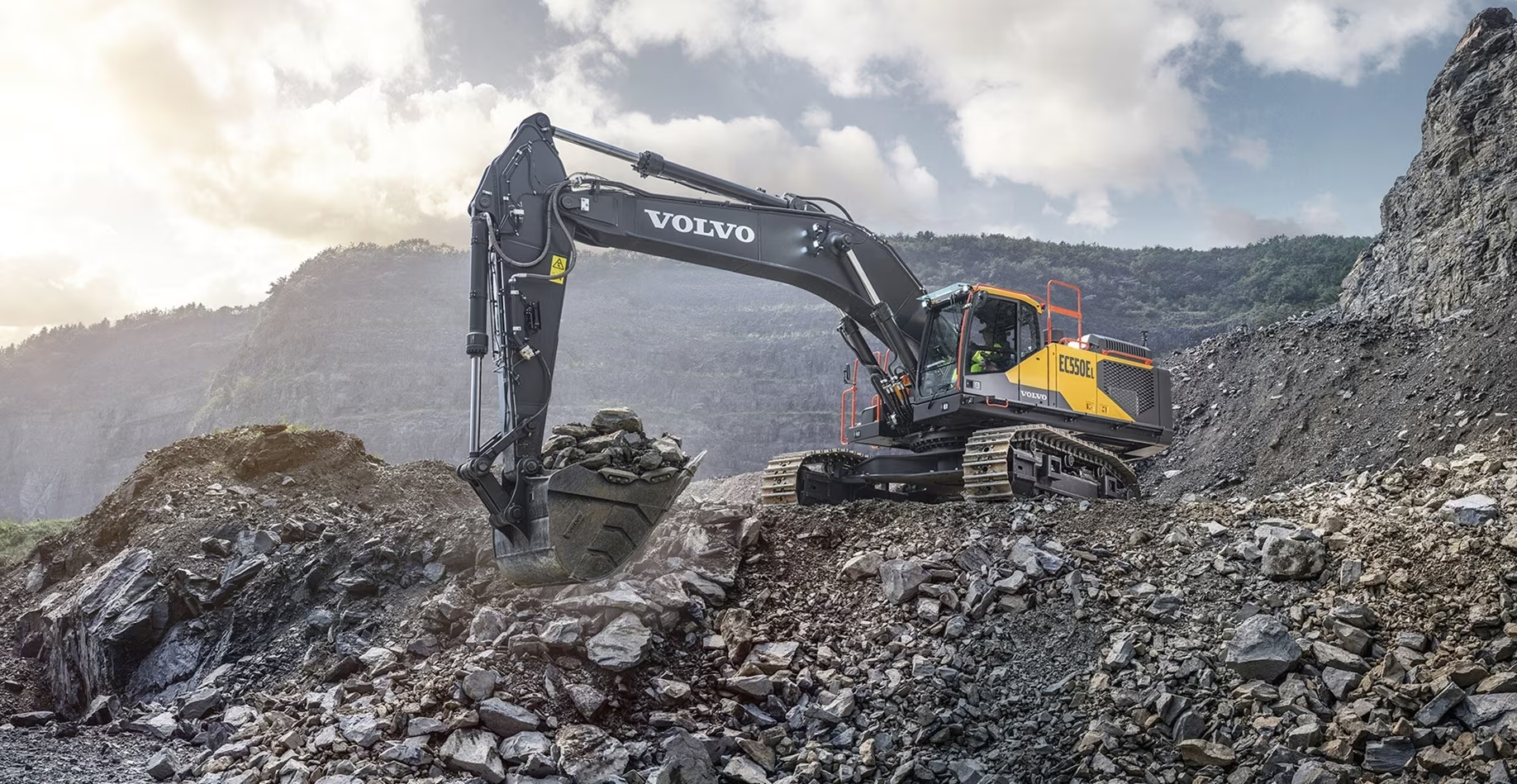
EC550E: The Versatility Play
The EC550E is a 50-ton-class excavator built for heavy-duty digging, mass excavation and large site preparation.
With an operating weight of 120,000 to 124,100 pounds and 456 gross horsepower, the EC550E offers a 40′ 0″ maximum digging reach and 25′ 3″ maximum digging depth — substantial capability without stepping into the transportation and site requirements of Volvo’s larger excavators. Bucket capacities range from 3.14 to 6 cubic yards, and breakout force reaches up to 60,500 lbf in boost mode. Its retractable undercarriage narrows the machine from 13′ 9″ to 12′ 2″ overall width, which can be useful when transport or site clearance is a consideration.
Choose the EC550E when:
- You need one machine that can move between different job types and sites
- Transport and relocation are recurring considerations
- You’re working in the 50-ton class and want a retractable undercarriage for tighter sites
- Your operation needs a balance of production capability and flexibility
The practical advantage is versatility. A machine that can move between jobs and stay productive across different applications — and narrow itself down for transport or confined work areas — can make more sense than a larger excavator that spends significant time waiting for work.
EC750E: The Production Workhorse
The EC750E steps into a different production class. With an operating weight of 162,040 to 166,008 pounds and 516 gross horsepower, it’s built for demanding applications where larger buckets, greater digging forces and sustained production matter.
This is the machine for operations moving beyond general excavation into heavy civil work, quarrying, large-scale site development and other applications where production volume is a priority.
The EC750E can be equipped with buckets ranging from 4.3 to 6.7 cubic yards, with breakout force up to 76,885 lbf in boost mode and tear out force up to 73,962 lbf. That additional bucket capacity and digging force can help reduce the number of passes needed to load larger haul trucks compared with a smaller excavator. Lifting capacity along the undercarriage reaches 67,184 pounds, giving it meaningfully more muscle than the EC550E for heavier lifts.
Choose the EC750E when:
- You’re consistently loading larger haul trucks and need more bucket capacity
- You’re handling dense, abrasive or blasted material
- The machine will remain on a large project for an extended period
- You need more production capacity than a 50-ton-class excavator can provide
- Your operation can support the transportation, service and infrastructure requirements of a larger machine
The EC750E occupies the middle ground between versatility and maximum production. It’s large enough to substantially increase material movement while remaining below the scale of the EC950F.
EC950F: Maximum Production
The EC950F is Volvo’s largest conventional crawler excavator, operating in the 100-ton U.S. class. With an operating weight of 201,227 to 209,020 pounds, it’s designed for high-volume applications where moving material efficiently is the priority.
The number that matters here is pass count.
For owners of large articulated haulers, Volvo designed the 100-ton EC950F excavator to pair with them. In fact, it can fill a 60-ton A60H haul truck in four bucket passes with an average cycle time of just over a minute. Fewer passes can mean less truck waiting time and more efficient use of the haul fleet.
The EC950F can accommodate buckets up to 10 cubic yards and delivers a 46′ 0″ maximum digging reach with a 29′ 4″ maximum digging depth — well beyond either smaller class. Breakout force reaches 76,660 lbf and tear out force reaches 78,683 lbf. That capability comes with a larger footprint: 14′ 8″ overall width and a 15′ 5″ tail swing radius, figures worth confirming against your site’s working clearances before committing.
The machine is designed with features intended to support both production and transportation, including a wide track gauge, long track length, retractable undercarriage and removable counterweight.
Choose the EC950F when:
- Cost per ton and production volume are major operating priorities
- You’re running A60H or comparable high-capacity articulated haulers
- The project is large enough to keep the machine consistently productive
- Quarrying, mining, heavy civil or large-scale mass excavation is central to your operation
- The additional production capacity justifies the transportation and support requirements of a 100-ton-class excavator
The honest caution: this machine rewards volume and consistent utilization. If you can’t keep it supplied with material and haul trucks, you’re paying for capacity you aren’t using.
What the Operator Notices
Fleet and procurement decisions tend to focus on tonnage, bucket capacity and cost per ton, but someone is sitting in that cab for a 10-hour shift. Visibility, controls, cab comfort, noise and vibration can all influence the operator’s experience and how consistently they can work throughout the day.
The three excavators offer different operator-focused features depending on the model and configuration:
- EC550E: Volvo emphasizes operator comfort and visibility, with an optional high-visibility cab and one-piece front window designed to provide wider sightlines. Volvo also offers Volvo Smart View, which uses cameras to provide an overhead view of the machine on the in-cab monitor.
- EC750E: The EC750E uses Volvo’s electro-hydraulic system and integrated work modes to give operators more control over machine performance. Its in-cab attachment management system can store hydraulic flow and pressure settings for up to 20 attachments. The High Reach (HR) configuration also offers a hydraulically tilting cab for high-reach applications.
- EC950F: The EC950F brings operator-focused technology to Volvo’s largest conventional crawler excavator. Features include ergonomically positioned controls, an LCD monitor, integrated work modes and an attachment management system that can store settings for up to 20 attachments.
Cab dimensions, seating and other operator-experience details can vary by model and configuration, so a hands-on comparison can be valuable when those factors matter to your team. Ascendum can help arrange time in the cab so your operators can evaluate visibility, controls, comfort and overall feel before you make a decision.
How to Actually Decide
Skip the spec sheets for a minute and answer four questions.
1. What are you loading?
Match the excavator to the truck, not the other way around. Consider bucket capacity, truck capacity, material density and expected cycle times when evaluating whether the excavator and haul fleet are properly matched.
2. How often does the machine move?
Transportation and setup requirements generally increase as machine size increases. A machine that relocates regularly has a very different economic profile from one that stays on a quarry bench or large excavation project for an extended period.
3. What’s the utilization forecast?
A larger machine doesn’t automatically deliver a better return. Be realistic about the work you actually have booked, the material you need to move and how consistently the machine can work. A smaller excavator running near full utilization can be a better fit than a larger machine spending significant time idle.
4. What does your support infrastructure look like?
Larger machines require more consideration around transportation, service, parts and technician support. Your dealer should be part of that conversation before you choose a machine class.
Where Ascendum Fits
Choosing the right excavator goes beyond comparing horsepower and bucket capacity. Parts availability, technician response time and dealer support all contribute to keeping the machine productive after it arrives on your site.
Ascendum Machinery’s product specialists can help you evaluate your application, haul fleet and production requirements to determine which Volvo excavator class makes the most sense for your operation.
The right answer may be the EC550E. It may be the EC750E. For a high-volume operation, the EC950F may be the better fit. The important thing is matching the machine to the work you actually need it to do.
Ready to size the right machine? Contact your local Ascendum Machinery branch to discuss your application and find the Volvo excavator that fits your operation.